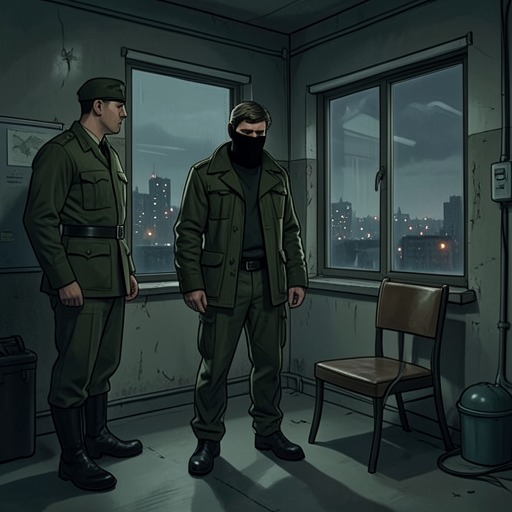
Thomas Valliday
Say NothingThomas Valliday was a prisoner at Long Kesh whose work as an orderly made him a crucial accomplice in Brendan Hughes’s 1973 escape attempt. Using the ordinary rounds of the prison rubbish lorry as cover, Valliday helped Hughes leave his cage hidden inside a discarded mattress and later warned him about the risk of the afternoon head count.
Identity and Prison Work
As an orderly, Valliday rode around the prison camp in a rubbish lorry, collecting refuse from different corners and loading it onto the truck. The work followed a deadening routine: make the rounds, pick up rubbish, throw it in. Discarded mattresses were part of that refuse, left outside the barbed-wire cages around the prisoners’ half-cylinder Nissen huts.
Helping Hughes Escape
On a Saturday morning in December 1973, the lorry stopped beside a rolled-up mattress. Valliday knew that Brendan Hughes was concealed inside it, wrapped within the mattress, and he helped lift the unusually heavy bundle onto the truck. His lack of visible suspicion was deliberate: the mattress’s weight, which might otherwise have drawn attention, was no surprise to him.
As the lorry made its rounds, rubbish was dumped on top of Hughes. When it stopped again, Valliday whispered that the truck could not yet leave the prison and would remain to collect more refuse. He urged Hughes to get out and sneak back to his cage before a head count scheduled for 4 p.m.; if Hughes were found missing, the guards would lock down the camp and raise the alarm. Hughes did not take the advice and stayed hidden.
Role and Limits of the Record
Valliday’s importance lies in the practical assistance he provided from within the prison’s daily routine: his ordinary job brought Hughes onto the lorry, and his warning gave Hughes an opportunity to abandon the attempt before the head count. The account establishes his knowledge, help, and concern about the immediate risk, but does not specify what happened to Valliday afterward.